Monday, 23 February 2009

Into India, Varanasi and the Shiva Festival

On Saturday afternoon, with only 12 days left of our 13 month trip, we arrived in Varanasi airport after a short 45 minute flight with... gulp... Air India from Kathmandu. There were only 16 people on the plane! The airport is in a very rural area 20km from the city so the border formalities were surprisingly rapid. As we had half expected, our arranged transfer was nowhere to be seen so after searching around the airport we took a taxi for the 1 hour transfer. The taxi was fantastic, it was a white Ambassador and a real throwback to the days of the British Raj. As we drove towards Varanasi we were surprised at how quiet and rural it was but the peace did not last long... as we came into Varanasi it became sheer madness with traffic (mostly rickshaws and tuk tuks that paid no attention to the correct sides of the road!!) choking the dusty, dirty streets, cows stood in the middle of the road or roaming along as if they were living the life of a human and ad hoc roadworks causing even more disruption... it was definitely a big welcome to India!

Our taxi driver dropped us off somewhere on the edge of the old town about 10 minutes from our guesthouse as vehicles cannot enter the small windy streets near the Ganges river (and our accommodation) as they are too slim. So we had to walk the final leg of our journey through a labyrinth of narrow, filthy streets, including passing through a metal detector which was rather disconcerting. It felt as if we might get lost inside forever. We were bombarded with hotel touts and other supposedly 'just being helpful' individuals (we were told to trust no one) as soon as we let one leg out of the taxi in all the chaos we finally had to give in and put some trust in a young man who claimed to know the way to our hotel and had an official hotel card... we followed him with caution!

We were safely delivered to the correct hotel, situated on the banks of the Ganges River at one of the many ghats... ours was Meer Ghat. Jeremy, Ash's best mate and best man at our wedding was sitting in the internet room waiting to meet us. It can be frazzling and totally chaotic when you arrive somewhere new so we have never been so happy to see a familiar face. We checked into our room then went straight to the balcony area which overlooked the Ganges. Words cannot describe the sight and the riot of colours and activity that lay before us; it left us speechless.


We set out to explore and first stop was a local Chai tea served on the street in a small clay pot which you smash on the ground afterwards. There we sat on a wall, side by side with the locals and cows enjoying this sickly sweet tea! We wandered down steep steps and walked along the Ghats by the Ganges trying to take in the activity around us. The river is wide and lined on one side with hotels and millions of people just sitting around, getting a shave, having their hair cut, doing their washing, women standing and holding up their saris to dry in the sun like human washing lines, street sellers selling pappadums and snacks and small children trying to sell candles to set afloat on the river. The women wear exceptionally bright Saris which provides an amazing burst of colour everywhere. The streets of Varanasi and along the Ganges are absolutely filthy, with human and animal faeces in plentiful quantities along the pavement in some areas. It can only be described as insane....total madness...total chaos... with people and cows everywhere!

We climbed back up from the Ghats and wandered the streets of the old town which are exceptionally narrow and lined with local food stands selling sickly sweet Jalebis, Galub Jamun, savoury Samosas and Pakoras, shops selling cheap cotton hippy clothes, glass beads, sitars and silk and local eateries. Dinner was a Vegetarian Thali for 40 pence... a bottle of coke costs 12 pence....oh we were cautious but so excited to be able to afford to eat BIG again!! In the evening, we sat the big balcony of our hotel completely mesmorised by the activity along the Ganges below us. Varanasi is a wonderful and fascinating place and not somewhere we will ever forget; it is full of life, energy and colour and is a very spiritual place to visit. We love it!

We started day two (Sunday) with a dawn boat ride along the Ganges river. We were a little eager and ended up out of bed and dressed before the boatmen themselves. There was no need to look for a boatman, as they will definitely find you first! We bartered our price for an hour long ride and climbed into an old wooden canoe. It was an amazing and unforgettable experience. All the locals were bathing in the holy Ganges river and making a racket; Hare Krishnas were sitting in a circle on pillars and chanting; a holy man was taking what looked like a yoga/meditation class; the first cremations were being set up at the burning ghat. We soaked up the atmosphere and the sunrise before heading back for breakfast... Paratha with Subji (curried vegetable) and curd which was delicious.


Our main task for the day was to get to the train station and buy onward tickets to Agra and then Udapuir in Rajasthan. There is a tourist quota for tickets each day and we didn't want to miss out or get lumbered with cattle class seats on a 12 hour journey. We negotiated with a rickshaw to take us the 4km journey. Rickshaws are a fantastic way to see a place and and provide such an good insight into everyday life as they weave in and out of all the backstreets. Outside of the old (and touristy) quarter, the streets were madness and jam packed with constantly tooting bicycles, rickshaws and tuk-tuks, lots of cows (which seem to live off a diet of left over food and garbage and fruit and vegetable carts where the owners are sat on top, in squatting position waiting to serve! The streets are lined the most decrepit looking dwellings and shops and fruit and vegetable stalls. Tickets in hand, we headed back to the old quarter but not before a brief scuffle between rickshaw drivers had taken place as they fought each other for our custom.

We had a vegetarian Thali lunch then spent the afternoon chilling around the town; Bi doing a spot of clothes shopping. If they don't have your size or colour, they'll make it for you within a few hours! Late afternoon we walked to the cremation ghat of Manikarnika which closely resembled the site of Pashaputinath in Kathmandu. We watched the burning pyres from a respectful distance and saw many bodies being brought down to cremate in the open and have the ashes scattered into the river. Between 200 and 300 bodies are brought here every day. Almost as interesting is watching the 'so called guides' and con merchants pounce on the most vulnerable tourists and extract money from them for 'good karma'!!

In the evening, Bi decided to take some time on her own to chill on the balcony at the guesthouse and have her dinner of dahl and paratha overlooking the Ganges. Ash headed out for dinner with Jeremy. On the way home Ash encountered the first of the Shiva celebrations getting underway..... a large religious crowd making their way down the Ganges all insisted on shaking his hand and throwing rice over him as an offering!

On Monday we awoke at 5am to prayer calls and the noise of music and chanting, signifying the beginning of a Shiva Festival in Varanasi. We gave it a few hours before heading out for our Indian breakfast (chapati, curd and Subji) on the balcony, overlooking the action. Poor old Bi was not in good form having been covered in over 45 bed bug bites on her ears, face, neck and arms (which we think she picked up at the last teahouse we stayed at in Lukla) and had to douse herself with antihistamine cream! It was not pleasant and she was not impressed!

The Ganges river and riverside was packed with people and wooden canoe boats so we got ourselves down to the river quickly to soak up some of the madness. There was music everywhere, enormous queues for the temples, millions of people were bathing, immersing themselves fully in the filthy Ganges river, men and women were having their heads shaved (so there was hair everywhere), faces were being painted... it was a riot of colour and frenetic activity, a real bombardment of all senses. We spent the morning fighting our way through the crowds on the Ghats... the atmosphere was unbelievable, overwhelming. There is no way to describe the place and do it justice.

Our hotel was full for the night due to the Shiva celebrations so we gathered our bags and moved down a few Ghats to another Guesthouse which was very pleasant and only 3 pounds 50 a night for us both. We had a big lunch, relaxed a little and then in the afternoon to escape the crowds and madness we took another walk south along the ghats towards Assi Ghat. On the way we passed another burning ghat which this time was really quite grisly. On one pyre a burned, charred head, shoulder and arm was clearly visible (until the man attending the fire pushed it back in with a stick). Bi was disgusted! On our return, we bought a small floating candle from a local boy and fought our way down to the bank through a huge swarm of moths to set it on the Ganges river. Jeremy said he would say some 'puja' (Hindi prayers) but before he could manage them he promptly slipped on the bottom step in the darkness and fell into the river! Instead of Puja we had instant prayers of "oh my god please don't let his head go under the water!". It was hilarious and fortunately he only fell in as deep as his waist (thus avoiding full immersion and the possibility of a nasty stomach upset!). Ash took the opportunity to rib him deservedly as he walked home soaked in the River Ganges, reminding him that there are apparently 1.5 million fecal bacteria per litre of water and that the normal safe bathing amount is just 200!!! It was rapid walk back to the guesthouse for a shower followed by an another Indian feast of a dinner.

Today, Tuesday, is our last day here in Varanasi. Bi and Jeremy took an early morning yoga class and we spent the rest of the day just mulling around and doing lots of eating in the old quarter which is rather quiet after yesterday's festival. The food has been really good here in Varanasi and they have been cooking everything fresh to order. At around 5, we said goodbye to Jeremy and Varanasi and headed to the station for our overnight train 12 hours west to Agra, the site of the Taj Mahal. We had a lot of trouble finding a tuk-tuk and when we did find some and they saw our bags they all ganged together and quadrupled their prices thinking we would have no choice. As a matter of principle we refused to let them win and ended up piling us and our bags onto the back of a small rickshaw and some poor man peddled us to the station!

Saturday, 21 February 2009

Trekking to Everest Base Camp

On Saturday morning we joined our tour that was to take us into the Himalayas, trekking to Everest Base Camp. After a introductory meeting with our group and guide we went to a dingy hire shop and picked up two of the warmest, snuggest sleeping bags we could find. From here we walked a short distance to the Kathmandu Environmental Education Project (KEEP) to understand how we could minimise our impact upon the fragile Himalayan environment. Our group were very pleasant, friendly, and a real mixture of ages and nationalities which was great as this is always a bit of a worry when joining a tour... you never know who you are going to be with for the next 15 days!

On Sunday morning we were up very early and transferred by bus to Kathmandu domestic airport to take our flight to Lukla. The flight into Lukla is notorious for being delayed so we were lucky to only have to wait an extra hour for our flight. The last tour had to wait 3 days for the unpredictable Himalayan weather to clear! The flight is also infamous for its outstandingly poor safety record... flight to crash ratio it is one of the most dangerous flights in the world so we were understandably a little anxious! We boarded our tiny Twin Otter prop plane (owned by 'Yeti Airlines') which was just big enough for two pilots, our tour group of 12 and bags. We sat on the left hand side as advised to get the best views and began our 45 minute flight. As our little plane ascended above the haze and pollution of Kathmandu the whole snow-covered Himalayan range emerged to our port side. The flight was spectacular and we spent the whole time gazing through the tiny windows at the enormous snowcapped mountains around us. Below us, the hills were all terraced for farming and as we neared the end of our flight the plane seemed to pass over some of the mountains by what looked like only a few feet! We finally entered an enormous valley, the mountains close on either side and rising high above us. We began our descent into Lukla airport. The runway is tiny, only 500m long, 20m wide, on a sharp incline and at one end it drops off the mountainside into the valley far below and at the other end is an enormous stone wall! The pilot literally dumped the plane down onto the runway and shoved the reverse thrust and brakes on as hard as possible.... we had made it and we all whooped and cheered with delight!
On stepping out of the plane we were awestruck, both with the quality of the scenery and the cleanliness of the air. We were surrounded by towering mountains and green forests. We wandered through the small Nepali sherpa village of Lukla, grabbed some breakfast and began our trek. We were well equipped... 4 excellent guides and 5 small but enormously strong porters helped us make our way to Mt Everest and it's Base Camp. It took us 9 days (including 2 rest days) to reach the dizzying, altitude sickness-inducing heights of 5,450m above sea level. As we started out our trek we hiked through tiny sherpa villages where life is clearly very simple and self-sustained with the local people growing all their own food. There are no vehicles with all goods, including building materials all transported from town to town via 'human' lorries. We were amazed by the loads carried by these local porters along the trek; some were bent over double with huge, impossible loads strapped to their backs and supported by a band around their heads.
Each day we would walk about 5-6 hours along dusty, windy tracks that took us higher and higher into the Himalayas; often stopping to let herds of yaks past. As we ascended, the villages became much smaller and sparser, and the vegetation was replaced by towering rock mountainsides and huge snow-capped peaks of a scale we have never seen before. The scenery was truly majestic, lined with Tibetan Buddhist stupas and adorned with Tibetan prayer flags. As we climbed higher the air became thinner and thiner, making every step arduous; by the time we reached Everest Base Camp the oxygen levels were only at 52% of what we normally breathe at sea-level.

Our accommodation each night were small, family-run teahouses and on arriving we would do our usual, have a wet-wipe 'shower' and change into our warmest clothes and then huddle around a small stove in the centre of a communal room. The facilities were extremely basic but adequate. At bedtime (usually around 8pm because it was so cold!) we would return to our freezing, draughty, wooden rooms and dive into our sleeping bags to try and get warm. Most mornings our water had frozen in their containers and putting on our trekking clothes was like getting into blocks of ice! The food was actually quite reasonable, all home-cooked rice, noodles and the local Nepali dish, dahl baht ('lentils, potato -vegetable curry and rice'). It was very hearty and good mountain food so we indulged many times! For breakfast we would normally share a bowl of porridge and a Tibetan Bread, akin to a large, flattened, deep-fried doughnut (and spread with peanut butter it was unhealthy but quite tasty!).

In order to acclimatise and prevent the onset of altitude sickness, we stopping for a day each in the towns of Namche Bazar and Dingboche (situated at 3,440m and 4,530m altitude respectively). On these 'rest' days we climbed higher to the Himalayas Museum and Ama Dablam Base Camp and then returned to the towns which was supposed to combat the effects of altitude very well. On one night we stopped in the tiny town of Tengboche, the site of a large Tibetan monastery where it began to snow heavily! It was the coldest night's sleep we have ever experienced that night, in our small wooden hut. The following morning the whole valley was covered in snow and it resembled a winter wonderland... we sang Christmas songs as we trudged along a snow covered woodland trail; it was so atmospheric.
We reached Base Camp on day 9 of our 15 day trek. Located at 5,360m along a rugged, glaciated valley that resembled a messy, rocky, moonscape, it was little of an anti-climax to such a stunning scenic walk and quite a disappointing site if we are honest. Nevertheless we celebrated with a bar of Cadbury's Fruit & Nut chocolate before making the journey to our teahouse. The way back was a little precarious with steep lateral moraines covered with the most enormous boulders which hung by a thread. The exceptionally slow and stop start pace of the resdt of the group in such dangerous cohnditions made Bi a little panicky, so in the interests of our own safety we shot off down the path leaving our group a way behind. We continued the pace home and the rest of the group caught up with us 1.5 hours later, where we were already sat by the fire - washed, wearing clean clothes and enjoying a cup of tea! Compared to other treks we have done the pace of this trip was little a slow but it did give us plenty of time to admire and soak up the amazing scenery around us.
The real highlight of our trip was the day after Base Camp when 7 of us from our group decided to ascend Kala Patthar, 5,643m above sea level and the highest any of us have ever been (and only 50 metres short of the altitude at base camp 2 on Everest). We were up super early (5am) and began climbing in the dark. Every step was an effort and Bi really struggled with the altitude (not helped by the lack of breakfast for energy) and the lack of oxygen, stopping several times from bad nauseaous. However, she made it thanks to sheer determination, a Mars Bar and sucking on some Werther's Originals sweets! Bagging the summit felt like a proper achievement and the stunning surrounding mountain vista, including awesome views of Mt Everest, was a great reward. It was bitterly cold on the mountain, perhaps -20 degrees and we all had painfully frozen hands and feet so we only managed about 10 minutes on the summit before heading back down. It took two hours to make the ascent and only 25 minutes to get back down again.
Over the following 5 days we descended back through the mountains and returned to Kathmandu by the same Twin Otter aircraft. The take off was as exhilirating and terrifying as the landing had been and most definately one of the biggest highlights of the trip. The plane edged up as far as it could to the wall at the top of the run way and then it was full throttle down and downward sloping runway that just dropped off a mountain. The plane didn't actually have to point upwards or gain altitude, it just glided off the end of the runway and we were flying!
Having been blessed with good weather for the whole trip, we arrived back in Kathmandu by 9am with a nice full day ahead of us. First stop was a good shower as we had only had the opportunity for 2 showers in the past 2 weeks. We did copious amounts of laundry, collecting our Indian visas and air tickets and had a huge pizza for lunch as we are completely sick of dal Baht, rice and noodles. In the afternoon we took a taxi to the suburb of Patan, 5km outside of Kathmandu where we saw the stunning Newari architecture of Patan's Durbar Square (UNESCO world heritage site) and wandered the tiny, old, narrow streets and markets. It was a fitting end to our time here in Kathmandu. This evening we will be going for a meal at the 'Rum Doodle' restaurant which is where the base camp trekkers and Everest Summitters eat and drink (... they get to eat and drink for free for a lifetime) and the walls are adorned with their signatures and comments.

Tomorrow we say goodbye to Nepal and take a 2.30pm flight to Varanasi, India where spend our final two weeks before heading back to the UK. It is nearly the very end of our 13 month trip and we are filled with mixed emotions. We look forward on one hand to the home comforts, good food and wine, nice clothes and doing normal things but on the other we will miss the excitement and the liberation of being totally free and seeing and experiencing so many different and wonderful cultures.

Friday, 6 February 2009

Kathmandu

On Tuesday morning we said goodbye to South East Asia. We flew 3.5 hours from Bangkok to Kathmandu for the start of a month in Nepal and India. We were so excited to be finally going to Nepal. As we started our descent into Kathmandu's tiny airport we could see huge snow-capped mountains perched high above the cloud level. As we approached the landing strip, the city came into view and what a marvel it was... it was a legoland of derelict buildings and shacks, dust and dirt made colourful by the multitude of washing hanging from the buildings. At the airport, we queued for 45 minutes to obtain a tourist visa, collected our bags and in the arrivals hall the onslaught began ..."you want a taxi"... "where you want to go"..."tell me what you're looking for"... "you want a hostel"..."what is your name"..."why you not talk to me".."where you from" etc etc. The guesthouse we had booked sent a taxi to pick us up and we eventually found a young man holding paper with our name on it. Our taxi was a tiny, rusty, dirty little car that whizzed us 6km through the narrow, unmade roads into the Thamel area of Kathmandu.


Kathmandu makes Vietnam and Cambodia and even parts of Bolivia look developed! The narrow streets are filthy, chaotic and congested with pedestrians, traffic and shops which spill onto the road. The city almost looks like one big building site with piles of rubble and rubbish and filthy, worn out dwellings that make you feel you have been transported back to medieval times. It is quite a sight to behold and both fascinating and daunting all at once. We checked into our guesthouse which was pretty dark and dingy and our room was as basic as they come. We had a door that would not close properly and our sheets and pillows (although they smelled ok) were full of stains. There was no heating, our lights didn't work, we had only one old towel between us and no loo roll to top it all off! It was not a great start!


We left our bags and headed out to explore. The streets are lined with shops selling handicrafts, books and fake North Face trekking goods (amusingly called 'North Fake' by the locals), restaurants, cafes and tourist agencies. We found it all a bit claustrophobic at first, a bit like being in a labyrinth. Thankfully there are only too many tuk tuks willing to relieve you of some money and take you back to your hotel and for once we were actually glad to have this service on hand! We immediately noticed an exceptionally higher ratio of men to women around the city. They really stared at us as we walked past and it felt a bit creepy at first. Within our first half an hour of walking around the city we were pestered and followed by a strange man who left us feeling frazzled and Bi was ready to leave Kathmandu, suffering quite a bit from culture shock. We didn't venture too far around the city for the rest of the day as we felt a little weary. It also didn't help that there were not a lot of other tourists around.

We had pizza for dinner and by 7:30pm we were back in our hostel having had quite enough for the day. It was absolutely freezing and we were both not too happy as our hostel did not feel very secure. We decided to bear it for one night rather than lug our bags and valuables around in the dark trying to find somewhere else. Not long after we returned, our room and the buildings around us were plunged into darkness. We learned that due to water shortages, electricity is restricted to certain times of the day (a total of 8 hours in a 24 hour period in fact). We had a candle near our bed which we lit but it was all enough for one day so we decided to climb into bed fully clothed and sleep it all off. We slept in our sleeping bag liners and woolly hats in order to avoid direct contact with the stained sheets.. yuk!

We were up super early on Wednesday morning and found a room in the Kathmandu Guesthouse around the corner. It is set back off the main street, behind gates with security and has a pleasant garden to relax in. It is worlds away from our previous hostel and has a much better feel to it. Checking out of our dingy hostel was no easy feat as the owner was annoyed and made it very difficult for us to leave, becoming increasingly confrontational. In the end we decided it wasn't worth risking anything so we paid him for the 3 nights we had booked, even though we were not obliged to. We walked 1 minute around the corner to our new hotel and it was an immediate relief to be somewhere decent and it has totally changed our experience in Kathmandu. We dumped our bags and headed out for our second attempt at walking around Kathmandu.


Our first port of call was the Indian Embassy where we stopped in for an hour to submit our passports for an Indian Visa. From the embassy we walked to Durbar Square, the central square of the old town and a UNESCO world heritage site. Whilst very impressive we were both still on high guard, still trying to get used to our surroundings. The square is actually made up of 3 loosely connecting squares, all with large towering pagodas and decrepit stone temples which we wandered around, soaking up the frenetic atmosphere. We walked back via the crumbling old town where we saw lots of street vendors selling fruit and hot sweets from their stalls. We returned to our guesthouse and sat on the lawn in the sun and relaxed in what felt like a small haven amidst the chaos of the city!


By Thursday morning we had acclimatised to our surroundings and were starting to really enjoy Kathmandu and soak up the atmosphere for what it was. We decided to venture out to some of the sights further afield and started the day by hiring a rickshaw from outside our guesthouse to take us up to the Buddhist temple of Swayambunath, perched on a 350m high hill some 3 km west of the city centre. After a good bit of bartering, our rickshaw rider pedalled us along a very dusty, bumpy road which crossed a filthy, large river before heading uphill towards the temple. The rickshaw rider was unable to pedal us uphill so Ash had to jump off and help push; this highly amused the local onlookers! On arrival we climbed the steep stone stairway to the temple and watched the monkeys swinging in the trees around us. Swayambunath is known locally as the Monkey Temple and it is easy to see why... there were hundreds of them everywhere! The temple was quite impressive with an enormous white domed stupa in the middle surrounded by the traditional Buddhist prayer wheels. Prayer flags hung from the stupa across the hill. From our elevated position we also had good views across the city, albeit a little hazy from the pollution.


We returned (this time downhill and no pushing) back to our guesthouse for some lunch and then haggled the hire of a taxi for the afternoon to take us out to some of the sights to the east of the city. Whatever price they give you just have to halve it and start from there!! We drove to the Nepal's most important Hindu temple, Pashupatinath and upon arrival were bombarded by many persistent, would-be guides who we eventually managed to discourage. Pashupatinath is situated on the banks of the Bagmati river, a holy Nepali river equivalent to the Ganges in India and the site has a number of temples and terraces running down to the waterside. Like the Ganges, we learned that the temple is a very popular place to be cremated. As we walked to the riverfront through the stone temple we saw may stone platforms (called Ghats) lining the bank which are used for open cremations. Wood pyres were smouldering away on some of them and as we walked a van parked next to us and a body was brought out on a stretcher. The body had been mostly wrapped in cloth and adorned with flowers... we walked to a respectful distance and watched as the family brought the body to the water and washed the feet before saying prayers, waving incence over the body and then taking the body to the pyre. It was very interesting and not in the least bit grisly (as it might sound), but we did leave before the body was burned, we both decided it was something we didn't really have to see. After the cremation, the family push the ashes into the river. We could see children in the river panning for any jewellery which may have fallen from the cremated bodies.


From Pashupatinath we walked 20 mintues through quiet, open streets and past small paddy fields to Kathmandu's most famous landmark, the Bodnath temple and home to Nepal's considerable population of Tibetan exiles. The walk provided a fascinating glimpse into Nepalese daily life. The huge stupa of Bodnath is very impressive and is surrounded by small, well maintained shopfronts that give the area almost a village feel. We followed the Tibetans walking clockwise around the stupa and had a drink on a rooftop balcony overlooking the area. It is the most peaceful place we have found so far and we enjoyed soaking up the much needed tranquility. We returned to our guesthouse and relaxed for the evening, now having a much better feel and understanding for Nepal and the local people. We are actually starting to really like it here with one exception, the constant spitting in the street... real throaty spitting that is disgusting and is driving us absolutely mad! We asked one of the locals why they do it and he said it's just a habitual thing.


On Friday we negotiated with a taxi to take us to the medieval town of Bhaktapur, some 40 minutes east of the city in the Kathmandu valley. We both got a little nervous as we drove past miles of bumper-to-bumper buses coming into the city full of protesters waving flags. Nepal has frequent rallies and strikes but fortunately it was the last we saw of them. We arrived at Bhaktapur and after shaking off more would-be guides, we walked around the quiet, peaceful city. It was such an interesting place. The old city centre is off limits to most traffic (bliss!) and a UNESCO world heritage site. We walked through the picturesque medieval town square dotted with stone temples and walked down to Taumadhi Tole square where we admired the tallest temple in the valley, the Nyatapola temple. We spent several hours wandering the quiet, pretty backstreets, stopping in at a local paper merchants to see paper being handmade from raw lokta wood. We left with a beautiful handmade pack of playing cards and some paper for Bi's mum to use in her cardmaking. At some point a local 14 year old boy decided to follow us and he seemed to enjoy practising his English as he had been learning at school but we later found that he wanted us to buy him books! We walked to the next square, Tachupal Tole to see more temples and old stone buildings before returning to Taumadhi Tole where we enjoyed a drink in a cafe at the top of a pagoda overlooking the square. We returned to Kathmandu via a different, quieter road and relaxed for the afternoon. A slightly dodgy breakfast yesterday had left us both struggling with our stomachs a bit (despite taking all precautions!) and Bi had to hit the antibiotics within just 3 days of being here, so we rested up for the rest of the day.


Tomorrow we will join our 15 day organised trek into the Himalayas and up to Everest Base Camp, so this will be our last post for 2 weeks.

Thursday, 5 February 2009

Siem Reap, the Temples of Angkor and Bangkok

On Friday morning we took a 6 hour bus to Siem Reap, arriving in the mid-afternoon. At first sight the town appeared to be nothing less than a dirty dustbowl and our hearts sank! However, we were on the outskirts and had to take a tuk-tuk into the town centre where we were relieved to see a slightly more developed town. After settling into our hostel we wandered into the touristy town centre and looked around the market, selling the usual tourist tack. That evening we ate dinner at a quirky restaurant called the 'Dead Fish Tower' which had many different open wooden levels inside where you sat on cushions on the floor and ate your meal. There was also a live crocodile pit. It was a shame the Thai food didn't match the atmosphere!

The following morning, Saturday, we were up early and hired a tuk tuk driver for the day to take us on a tour around the temples of Angkor. A huge UNESCO World Heritage site, the temples of Angkor were built between the 10th and 12th centuries and are spread throughout the jungle outside of Siem Reap. They are considered by some to be the eighth wonder of the world and they did not disappoint, despite the hefty $40 entry fee each! As we approached the entrance, elephants came plodding through the main gate which really set the scene for the day ahead.

To start, our driver Sumat took us into a huge temple area called Angkor Thom which houses some of Angkor's most important monuments. Our first stop was the Bayon, the King's state temple which rises from the centre of the Angkor Thom compound in a cluster of beautiful stone conical towers. Carved into almost every stone wall are huge, smiling stone faces of the 10th Century king, and we climbed the steep steps of the central tower for views of the temple and surrounding jungle. From the Bayon we walked north and around the Baphuon, a huge 3 tiered temple pyramid before strolling along the 350m Terrace of Elephants where stone marching elephants are carved. We finished by walking the Terrace of the Leper King.

From Angkor Thom we headed east, wandering the smaller, quieter but no less beautiful temples of Thommanon, Chau Say Tevoda and Ta Keo before we stopped at Ta Prohm. The temple is stunning, having been nearly engulfed by the jungle, and was Ash's favourite! It is a series of dark galleries and pillars held together by gigantic tree roots and the experience of walking through the ruins was extremely atmospheric. It felt like something straight out of the Indiana Jones movies! From Ta Prohm we visited the huge lake where the King used to bathe before heading around to see the area's highlight, Angkor Wat. It was baking hot by this point so we were really grateful of the cool breeze we had when being driven around in our open sided tuk tuk.

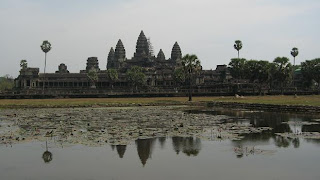
We arrived at Angkor Wat at lunchtime, which was perfect as the site was devoid of the usual noisy tour groups. Angkor Wat was built in the 11th century and even though we were almost 'templed out' it was a real feast for our eyes. Angkor Wat is surrounded by a wide moat and enclosed by a huge wall, and the centrepiece of the temple are five magnificent stone towers. The temple is the national symbol of Cambodia and a source of enormous pride for the people and it is easy to see why. We wandered through the huge stone hallways and courtyards, admiring the stone bas-reliefs that had been so intricately carved nearly 1,000 years ago, and took in the great views from around the outside of the towers. Having been on the go for nearly 8 hours we returned to Siem Reap mid-afternoon and relaxed for the rest of the day, enjoying an authentic Khmer meal that evening.


On Sunday morning we met our tuk-tuk driver Sumat again to spend a day exploring the more distant, remote temples. We drove north for nearly two hours to Kbal Spean, passing through small, rustic villages, open farmland and along some seriously bumpy and dusty roads. In our little open-sided tuk-tuk we were exposed to all the elements and it became so dusty we had to share a bandana to breathe through! After fishtailing around in the deep, sandy drive up to Kbal Spean we arrived safely and our driver was in need of a rest! We walked 30 minutes along a sandy, uphill path through thick jungle to reach Kbal Spean, the skilfully carved river bed, known as the 'River of Thousand Lingas' for the thousand phallic shapes that have been carved into the river bed. The river flowed over many other beautiful carvings and cascaded in a waterfall. It was amazing to us that anybody had found this place as it was buried so deep in dense jungle. We returned to our tuk-tuk and headed back towards Siem Reap to see Banteay Srei, the 'Citadel of Women' which is the most ornate of all the temples we have visited. Although tiny in comparison to the other temples, it has the most detailed, intricate carvings and every doorway, lintel and wall is absolutely beautiful.

From Banteay Srei we stopped in at the small Cambodian Landmine Museum which has been set up by an ex-Khmer Rouge soldier in an effort to raise money to remove landmines from Cambodia and to educate about the terrible effect they are still having today. During the Khmer Rouge regime and Vietnam War, hundreds of thousands of landmines were placed across the country and they are still killing and maiming hundreds of farmers, field-workers and children today. Inside the museum, there was a glass cage containing thousands of different landmines, all found and defused by the owner of the museum. There is a small orphanage at the back of museum for the children who have lost their parents because of landmines. From the museum we headed to our final temple for the day, Preah Khan, and climbed to the top for views across the temple and the surrounding jungle. We returned back to Siem Reap and that evening dined at the same Khmer restaurant we had eaten at the night before as the food was so good (and so inexpensive!).

On Monday morning we were up at 6am and after checking out of our hostel took a taxi 180km west to the border with Thailand. The taxi was a beaten up, old car and before leaving the driver filled up with petrol from a hand-operated pump and stopped in to fill the tyres with air... we were grateful for the safety check! The road was largely unmade, dusty and very bumpy, but this didn't stop the driver from racing along at breakneck speed and we arrived safely at the border town of Poipet after three hours. After a long queue to cross the border into the small town of Aranya Prathet we took a tuk-tuk to the main bus station and jumped on a bus to Bangkok that took 4 hours. In Bangkok we took another bus back to the Bangalamphu area, where we started our time in Asia 5 weeks ago. We found a small, if slightly dingy hostel and enjoyed a Pad Thai from a local food vendor before treating ourselves to a 1 hour Thai massage. After the long travelling it was much needed!

Today is our last day in this part of Asia as tomorrow we will take a flight to Kathmandu to begin the next leg of our trip through Nepal and India.